Sourcing or specifying spherical magnetic components for industrial, technical, or commercial integration presents unique engineering challenges. Designers frequently struggle to balance high magnetic performance against strict dimensional tolerances. Coating durability and rigorous compliance standards further complicate the selection process. The spherical geometry naturally alters magnetic flux distribution. It also changes surface wear patterns compared to standard blocks or cylinders. Without a clear specification strategy, you risk component failure, compliance violations, or supply chain bottlenecks. This article provides an evidence-based framework for evaluating Ball Magnet specifications. We will guide you through material grades, dimensional accuracy, and specialized coating selection. You will also learn how to mitigate application risks and shortlist qualified suppliers. Whether you design robotic linkages or consumer products, these insights help you make informed procurement decisions.
Key Takeaways
- Material Selection dictates limits: Neodymium (NdFeB) dominates ball magnet applications, but specific grades (e.g., N35 vs. N52, high-temp variants) must align with the operating environment.
- Tolerances are critical for spherical shapes: Machining precision directly impacts performance in kinematic and sensor applications.
- Compliance is non-negotiable: Strict consumer safety regulations (e.g., CPSC) and industrial standards (RoHS/REACH) heavily influence procurement viability.
- Surface protection prevents failure: The geometric wear profile of a ball magnet requires specialized coating strategies to prevent chipping and corrosion.
Core Specifications: Evaluating Material Grades and Tolerances
NdFeB Grade Trade-offs
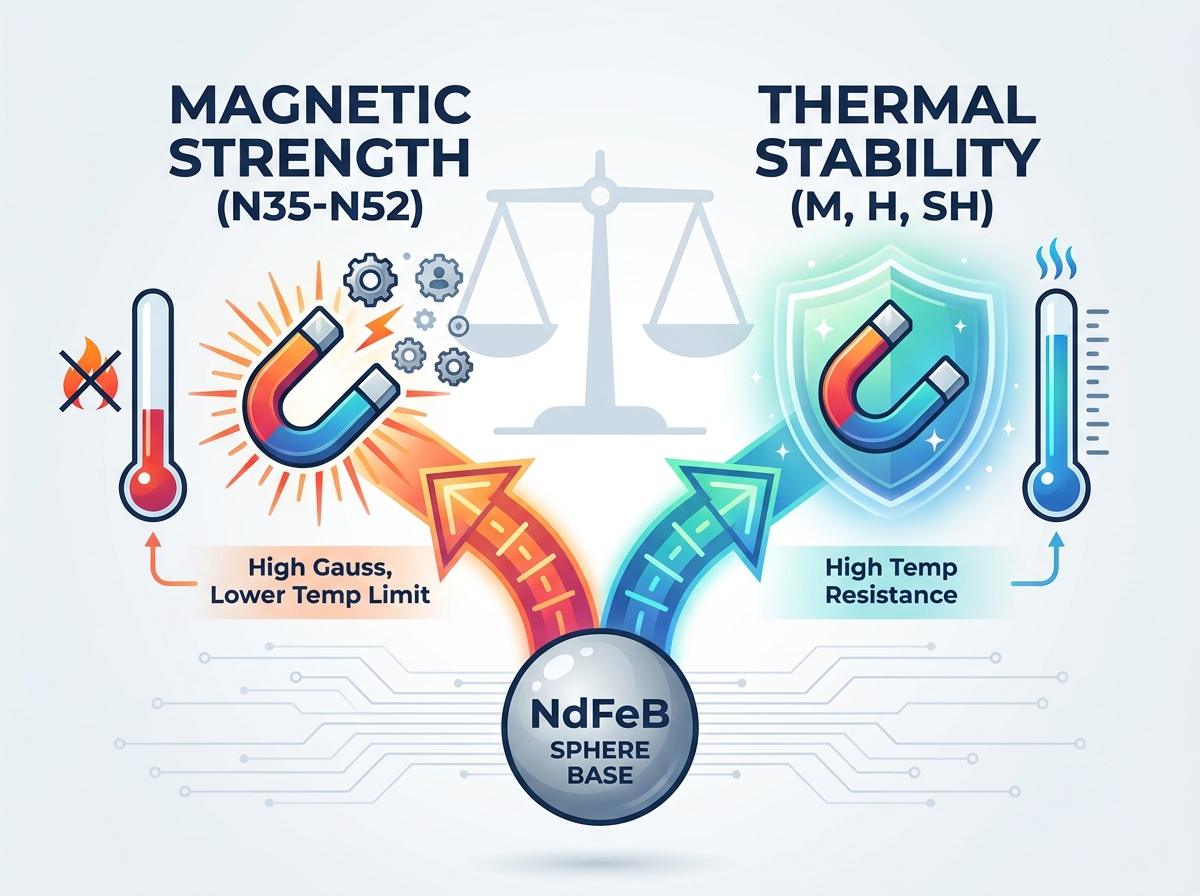
You must carefully select the right Neodymium (NdFeB) grade for your application. Engineers often chase the highest magnetic strength, typically N52. However, maximizing strength often sacrifices thermal stability. Standard grades (N35 to N52) operate safely up to 80°C. Exceeding this threshold causes irreversible demagnetization. If your application involves high heat, you must specify high-temperature variants. The M, H, and SH series incorporate elements like Dysprosium to increase coercivity. This prevents magnetic degradation in extreme environments.
Spherical geometry drastically affects Gauss and pull force readings. A sphere concentrates the magnetic field at its precise poles. Because a sphere only offers point-contact against a flat surface, it introduces an inherent air gap. This geometry yields lower theoretical pull forces compared to cylinders or blocks of identical mass. You must account for this point-contact reduction during your design phase.
NdFeB Grade Thermal Stability Comparison
| Grade Series | Maximum Operating Temperature (°C) | Relative Coercivity | Best Application Environment |
| Standard (N35 - N52) | 80°C | Standard | Consumer goods, standard room-temp sensors |
| M Series (e.g., N45M) | 100°C | Moderate | Warm industrial environments, motors |
| H Series (e.g., N42H) | 120°C | High | Automotive sensors, moderate-heat machinery |
| SH Series (e.g., N38SH) | 150°C | Very High | High-performance robotics, heavy industrial use |
Dimensional Accuracy and Grinding Realities
Manufacturers produce standard ball magnets with tolerances between ±0.05mm. Precision applications require tighter tolerances, often reaching ±0.01mm. Achieving these dimensions involves complex manufacturing realities. Suppliers press and sinter NdFeB into blocks first. They then cut these blocks and use centerless grinding techniques to form perfect spheres. This intensive grinding process increases material waste. Consequently, specifying tighter tolerances directly increases unit costs and extends lead times.
Axial vs. Diametrical Magnetization
Most spherical magnets feature axial magnetization. The manufacturer magnetizes the sphere directly through its diameter. This creates a distinct North pole on one side and a South pole on the exact opposite side. Verifying polarity during prototyping proves challenging due to the uniform shape. You can verify pole orientation using magnetic viewing film. Alternatively, you can allow a known magnet to naturally align with the sphere to find the exact poles.
Coating and Surface Protection Strategies
The Vulnerability of Spherical Geometries
Spherical magnets face severe mechanical vulnerabilities. Their point-contact nature concentrates all impact forces onto a microscopic surface area. Sintered Neodymium is inherently brittle. When two spheres collide, the impact easily chips the material. Once the outer coating fractures, the exposed NdFeB rapidly oxidizes and degrades. Protecting this geometry requires robust surface treatments.
Evaluating Coating Options
You must specify the correct coating based on environmental exposure and mechanical stress. The industry relies on several standard options:
- Nickel-Copper-Nickel (Ni-Cu-Ni): This triple-layer plating serves as the industry standard. It provides excellent baseline corrosion resistance and structural integrity. It presents a shiny, smooth finish ideal for most applications.
- Epoxy Coatings: Epoxy delivers superior performance in humid, acidic, or marine environments. It resists salt spray better than Nickel. However, epoxy adds slight thickness, which marginally increases the air gap and friction.
- Zinc and Specialty Finishes: Specify Zinc for lower-cost, low-humidity requirements. You can also specify Teflon (PTFE) for applications demanding low-friction mechanical interactions.
Verification
Never assume coating quality. You should require strict verification data from your manufacturer. Follow these steps to ensure coating integrity:
- Request standardized Salt Spray Test (SST) data. Look for a minimum of 24 to 48 hours of resistance for standard Nickel, or 72+ hours for Epoxy.
- Demand cross-hatch adhesion test results. This proves the coating securely bonds to the raw NdFeB material.
- Conduct physical drop tests during your prototyping phase to measure impact resistance.
- Measure coating thickness using X-ray fluorescence (XRF) equipment to confirm supplier specifications.
Primary Industrial and Commercial Applications
Kinematics and Magnetic Ball Joints
Engineers frequently integrate these components into kinematic systems. You will find them in 3D printer delta arms, robotic linkages, and articulating camera mounts. A Ball Magnet enables smooth, multi-axis rotation without complex mechanical hinges. Success depends on evaluating holding force under dynamic shear stress. The magnet must maintain joint integrity while allowing low-friction articulation.
Sensors and Switches
Spherical magnets excel in sensor triggering. Systems use them alongside Hall effect sensors, reed switches, and flow meters. Their uniform shape allows precise field mapping. Success in sensor applications requires absolute uniformity of the magnetic field. You also need precise dimensional tolerances. Even minor grinding defects will cause irregular sensor readings.
Filtration and Separation
Industrial fluid systems utilize these components for filtration. They capture microscopic ferrous particulates from oil, water, or chemical streams. Their smooth surface allows for easy cleaning and particulate removal during maintenance cycles.
Consumer and Educational Products
The consumer market uses them heavily for educational tools and desk toys. However, safety standards have forced a shift in design. Manufacturers now specify much larger diameters to prevent swallowing hazards. This sizing shift maintains product functionality while strictly adhering to international safety guidelines.
Safety, Compliance, and Regulatory Risks
Consumer Safety Regulations (CPSC and Global Equivalents)
Integrating rare-earth magnets into consumer goods introduces strict legal liabilities. In the United States, the Consumer Product Safety Commission (CPSC) enforces 16 CFR Part 1240. This regulation explicitly targets small, high-powered magnets. You must evaluate your design against the "small parts cylinder" test. If a magnet fits entirely inside this standardized cylinder, it qualifies as a small part. You must then calculate the magnetic flux index. If the flux index exceeds 50 kG²mm², the CPSC bans the component for consumer products. Failing to evaluate these metrics invites product recalls and severe legal penalties.
Industrial Compliance
Industrial procurement requires different compliance checks. You must verify supplier adherence to RoHS (Restriction of Hazardous Substances). This ensures the magnets contain no banned heavy metals. You also need REACH compliance for chemical safety. Furthermore, ethical procurement policies dictate strict conflict-mineral reporting. Always request documentation proving raw rare-earth materials originate from compliant supply chains.
Handling and Assembly Risks
Manufacturing lines face significant handling risks. High-grade neodymium spheres snap together with violent force. This creates severe pinch hazards for assembly workers. The resulting collisions also cause collision-induced shattering. These impacts create sharp shrapnel and highly flammable magnetic dust. You should manage these risks by using non-magnetic assembly jigs. Introduce automated spacers during manual processing. Always mandate safety glasses for personnel handling unassembled spheres.
Procurement Checklist: How to Vet a Ball Magnet Supplier
Requesting Raw Data
Do not accept generic data sheets. Buyers must demand specific demagnetization curves (B-H curves). You need the curve corresponding exactly to your quoted grade and operating temperature. This raw data proves the material will survive your application environment without losing field strength.
Batch Consistency
A supplier might produce a perfect prototype but fail during mass production. You must assess their Quality Assurance (QA) protocols. Ask how they maintain magnetic flux and dimensional tolerance across high-volume runs. Request their Process Capability Index (Cpk) data for grinding tolerances. A Cpk above 1.33 indicates a highly stable manufacturing process.
Prototyping to Production
Transitioning from prototyping to production requires careful documentation. Request a First Article Inspection (FAI) report before approving bulk manufacturing. This report verifies dimensional accuracy and coating thickness on the first production run. You must also evaluate lead times. Off-the-shelf spherical magnets ship quickly. Custom diameters, however, require dedicated grinding setups, which can add weeks to your timeline.
Red Flags
Avoid suppliers who make unrealistic physical claims. A major red flag is a manufacturer over-promising N52 performance at elevated temperatures. Physics dictates high-grade standard neodymium degrades rapidly under heat. If a supplier promises 120°C stability on an N52 magnet without specifying a high-coercivity (H or SH) formulation, they lack technical expertise or transparency. Disqualify them immediately.
Conclusion
- Transitioning from engineering specification to commercial procurement requires balancing physics with supplier capabilities.
- Successful integration demands equal attention to magnetic strength, precise dimensional grinding, and strict regulatory compliance.
- Always define your exact thermal limits before engaging suppliers.
- Establish rigid size constraints and compliance needs (like CPSC or RoHS) to avoid legal liabilities.
- Use structured verification data, such as B-H curves and FAI reports, to finalize your procurement decisions.
FAQ
Q: What is the strongest grade available for a neodymium ball magnet?
A: The strongest widely available grade is N52. It offers the highest magnetic flux density. However, this strength comes with significant trade-offs. N52 magnets are highly brittle and lack thermal stability. They typically lose magnetization if exposed to temperatures exceeding 80°C. You must carefully weigh raw strength against environmental factors.
Q: How is a ball magnet magnetized?
A: Manufacturers mostly magnetize them axially. The magnetic field runs straight through the diameter of the sphere. This creates a distinct North pole on one side and a South pole on the exact opposite side. Because the shape is perfectly uniform, identifying these poles requires magnetic viewing film or a separate reference magnet.
Q: Are rare-earth ball magnets legal to use in products?
A: They are perfectly legal for industrial use. However, consumer products face strict regulations. In the US, the CPSC prohibits small, high-flux magnets in toys or general consumer goods if they fit inside a small parts cylinder and exceed a specific magnetic flux index. Always consult local regulations before launching consumer-facing integrations.
Q: Can ball magnets be machined or drilled after purchase?
A: We strongly advise against machining them. NdFeB is exceptionally brittle; drilling will likely shatter the sphere. Machining also destroys the anti-corrosion protective coating, guaranteeing rapid oxidation. Furthermore, the friction from drilling creates highly combustible magnetic dust, presenting a severe fire hazard in your workshop.
Q: How do I measure the pull force of a spherical magnet?
A: You must test pull force under specific conditions because point-contact geometry yields lower practical pull forces compared to disc or block magnets. Attach the sphere to a standardized steel plate. Use a digital force gauge to pull the magnet perpendicularly away from the surface until it detaches, recording the maximum force exerted.