Modern engineering demands a delicate balance of spatial constraints, unit economics, and raw magnetic strength during product development. When designing compact electronics or high-efficiency motors, engineers often hit a wall trying to source the right magnetic components. Sticking to standard options can compromise your assembly, while over-specifying leads to wasted budget. Standard N40 neodymium (NdFeB) magnets sit right in the middle of the performance spectrum. They offer a highly reliable equilibrium of holding power and production cost.
Moving from off-the-shelf magnetic components to bespoke geometries requires careful evaluation of technical specifications and vendor capabilities. You must consider environmental factors, structural integrity, and long-term production scaling. In this article, you will learn how to decode the N40 grade and compare it against other neodymium options. We will explore core industrial applications, essential design specifications, and actionable tips for selecting a reliable manufacturing partner to bring your bespoke designs to life.
Key Takeaways
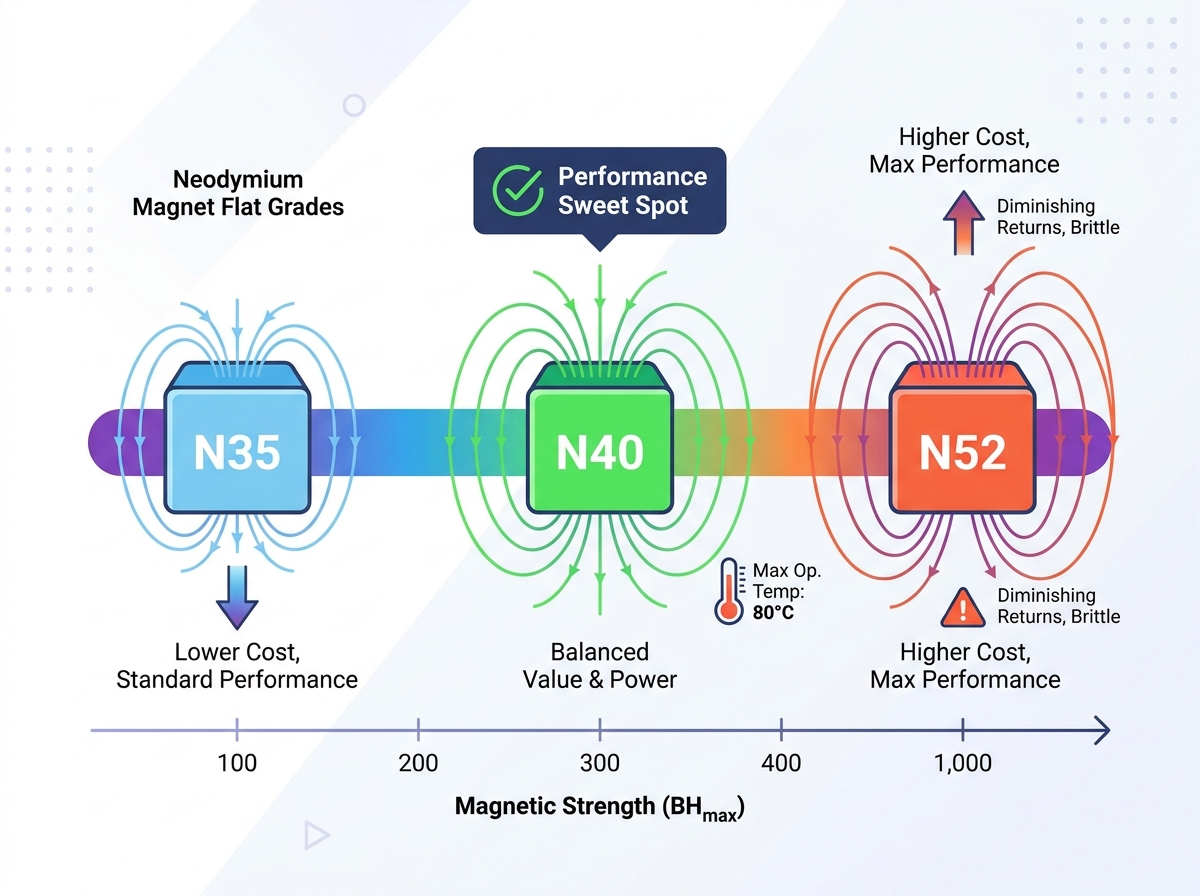
- Performance Sweet Spot: An N40 grade delivers a Maximum Energy Product (BHmax) of 38–41 MGOe, offering a reliable middle ground between standard N35 and premium N52 grades.
- Application Specificity: Designing a custom N40 magnet allows for precise control over geometry, magnetization direction, and environmental protection (coatings).
- Thermal Limitations: Standard N40 magnets max out at an 80°C operating temperature; exceeding this requires high-temperature variants (e.g., N40H or N40SH).
- Partner Selection: Engaging a qualified custom magnet manufacturer early reduces prototyping cycles and ensures compliance with tight dimensional tolerances.
Decoding the N40 Grade: Cost vs. Performance Trade-Offs
What does the "40" actually mean in practical terms? Engineers use Maximum Energy Product (BHmax) to quantify magnetic strength. The scientific unit of measurement is Mega-Gauss Oersteds (MGOe). An N40 grade component generates a BHmax between 38 and 41 MGOe. This raw physics translates directly into formidable holding force and dense magnetic flux. You can achieve surprisingly strong pull forces in very small volumes. It gives engineers immense freedom to innovate.
Why should you upgrade from an N35 to an N40? Many legacy designs rely heavily on N35. It serves as the baseline entry-level grade for consumer goods. However, upgrading to N40 delivers a 10 to 15 percent tangible increase in magnetic strength. This easily justifies the marginal material cost increase when aggressive miniaturization matters. If you must shrink a sensor enclosure by a few millimeters, an N40 component provides the exact same magnetic field as a much bulkier N35 unit.
Conversely, why would you downgrade from a premium N52? Everyone instinctively wants maximum power. Premium N52 grades offer immense strength. However, N52 parts suffer from steep diminishing returns. They cost significantly more to produce and source. They also exhibit substantially increased brittleness. When an N40 element suffices for your target application, you save money. You also improve the mechanical durability of your assembly.
You must rigorously understand operating assumptions before finalizing your blueprints. Unmodified N40 magnets are highly susceptible to irreversible demagnetization above 80°C (176°F). This baseline temperature serves as a strict ceiling. If you expose the material to higher heat, it permanently loses its structural magnetism. You will need a high-temperature variant to safely exceed this thermal limit. Suffixes like H, SH, or UH attached to the grade denote these specialized thermal capabilities.
| Magnet Grade | BHmax Range (MGOe) | Relative Production Cost | Primary Use Case Scenario |
| N35 | 33 - 35 | Low | Baseline consumer electronics |
| N40 | 38 - 41 | Medium | Miniaturized industrial assemblies |
| N52 | 49 - 52 | High | Extreme size constraints |
Technical and Commercial Benefits of a Custom N40 Magnet
You gain massive structural advantages when designing a Custom N40 Magnet. First, look deeply at space and weight efficiency. Neodymium packs immense energy density per cubic centimeter. Engineers rely heavily on this unique physical trait. You can drastically reduce the overall footprint of your assemblies. Compare this modern material to older ferrite or AlNiCo alternatives. A tiny neodymium block easily outperforms a massive ferrite ring. This helps you build sleeker, far lighter products.
Predictable supply chain economics also play a crucial role in modern manufacturing. Foundries produce N40 globally in massive quantities. It operates as a widely adopted, highly demanded mid-tier grade. This high production volume ensures relatively stable raw material availability year-round. You avoid the wild spot-price fluctuations typically seen in ultra-premium grades. Procurement teams can lock in more predictable bulk pricing agreements. This stability makes long-term production forecasting much easier.
Tailored integration stands out as another primary benefit. Standard commercial shapes rarely fit perfectly into highly complex modern designs. Bespoke dimensions eliminate frustrating, time-consuming mechanical workarounds. You can order complex arcs, slotted blocks, or perfectly countersunk rings. These precise bespoke shapes drop seamlessly into your final product assembly. You speed up manufacturing lines, lower labor hours, and drastically reduce structural failure points.
Core Industrial and Commercial Applications
Where do these versatile components actually go? You will find them heavily utilized across dozens of critical modern sectors.
- Electric Motors and Generators: Manufacturers heavily utilize them in BLDC (Brushless DC) motors. Custom N40 arcs provide the necessary torque for incredibly smooth operation. You achieve high electrical efficiency without over-engineering the rotor assembly.
- Sensors and Magnetic Switches: Precision systems demand completely reliable inputs. Hall-effect sensors require very consistent magnetic fields to trigger correctly. Engineers design bespoke components featuring custom multipole magnetization. This guarantees highly accurate trigger points in complex automotive and industrial sensors.
- Magnetic Couplings and Fasteners: Industrial pumps rely entirely on strong holding forces. High-end consumer goods also require satisfying, solid closures. Bespoke neodymium parts deliver strong, reliable breakaway forces. They maintain air-tight seals in dangerous chemical pumps without requiring any direct mechanical contact.
Specifying Custom Magnets: Implementation and Risk Mitigation
You must carefully specify your exact technical requirements to mitigate risks. Purchasing Custom magnets demands rigorous technical documentation and clear communication. Start by explicitly defining geometry and tolerances. Standard manufacturing tolerances usually sit at ±0.1mm. This covers most basic mechanical applications. However, precision assemblies often require an exacting ±0.05mm. These tighter tolerances carry significant cost implications. You force the factory to run slower grinding cycles and scrap more imperfect units. Only specify ±0.05mm if your tight assembly absolutely demands it.
You must also aggressively mitigate environmental corrosion risks. Bare neodymium remains highly reactive. It oxidizes incredibly fast when exposed to basic humidity. You must apply a robust protective layer. Compare these protective coating options based on your target operational environment:
- Ni-Cu-Ni (Nickel-Copper-Nickel): The absolute industry standard. It provides a highly durable, shiny finish perfectly suitable for most indoor conditions.
- Zinc: A slightly thinner, cheaper alternative. It works very well for protected, low-humidity environments.
- Epoxy: Offers exceptionally excellent salt spray resistance. Engineers reliably select this for tough marine or heavy outdoor applications.
- Parylene: A premium, vacuum-deposited polymer. It provides flawless medical-grade protection without adding significant bulk or thickness.
Finally, establish your magnetization orientation as early as possible. You must fully define this vital metric during the design phase before tooling begins. Will the magnetic flux travel axially, diametrically, or radially? You absolutely cannot change this after the foundry presses the raw material. Fixing an incorrect orientation requires a completely new, expensive production run.
Evaluating a Custom Magnet Manufacturer
Your engineering success heavily depends on vendor selection. Engaging a reliable Custom magnet manufacturer removes major technical roadblocks. First, demand robust engineering support from your chosen partner. Look for factories offering detailed finite element analysis (FEA). They can simulate complex magnetic circuits before physical prototyping even begins. You catch critical design flaws early in the software environment. This proactive step saves thousands of dollars in wasted tooling and lost time.
Quality assurance and data traceability cleanly separate premium vendors from basic suppliers. A trustworthy manufacturing partner eagerly provides extensive technical documentation. You should routinely request accurate hysteresis graphs. These specific demagnetization curves prove the raw material meets your specified BHmax. You should also demand detailed salt spray test reports to verify optimal coating thickness. Ensure the production facility complies strictly with major industrial standards. ISO 9001 and IATF 16949 certifications indicate highly mature process control.
Assess the vendor's long-term production scalability. Small prototype runs behave very differently than massive global mass production. Discuss their exact transition plan from rapid prototyping to high-volume offshore or domestic manufacturing. You need absolute, documented assurance that quality will not degrade when order quantities jump from hundreds to millions.
Conclusion
Bespoke N40 neodymium elements provide exceptional strategic value. They serve as a highly versatile, highly effective solution for modern engineering challenges. They perfectly bridge the structural gap between weak baseline materials and overpriced premium grades. You gain complete control over critical dimensions, protective coatings, and exact flux orientation.
We highly recommend taking immediate action on your upcoming product designs. Advise your procurement and engineering teams to thoroughly audit current magnetic assemblies. Identify precisely where standard off-the-shelf parts cause friction, bulk, or failure. Then, request an FEA simulation or a custom prototype quote from a verified manufacturer. You will uncover entirely new ways to optimize internal space, reduce final assembly weight, and stabilize your corporate supply chain.
FAQ
Q: What is the maximum operating temperature of an N40 magnet?
A: Standard N40 magnets function reliably up to 80°C (176°F). If you expose them to higher heat, they suffer irreversible demagnetization. You must use specialized high-temperature variants for hotter environments. Grades like N40H reach 120°C, while N40SH withstands up to 150°C without losing structural magnetism.
Q: How long does it take to prototype custom magnets?
A: Prototyping typically takes three to five weeks. This timeline depends heavily on your specific tooling and protective coating requirements. Standard block shapes machine quite quickly. Complex radial rings require bespoke pressing dies and extended sintering schedules, frequently pushing lead times toward the longer end of that window.
Q: Are N40 magnets prone to chipping or cracking?
A: Yes, all sintered neodymium magnets exhibit inherent brittleness. They behave much more like ceramics than tough metals. You must handle them carefully to prevent shattering upon heavy impact. We highly recommend adding chamfered edges to your custom designs to significantly reduce chipping during automated assembly.
Q: How do I verify the magnetic grade I receive is actually N40?
A: You verify grades through rigorous physical testing. Engineers use a Helmholtz coil to measure the total magnetic moment of a given sample accurately. You can also use flux meter testing to check surface Gauss levels. Always request comprehensive QA reports and demagnetization curves from your supplier before accepting shipments.