Industrial reliance on the permanent magnet is growing at an unprecedented rate. Electrification, automation, and renewable energy goals drive this massive demand. Manufacturers face unpredictable material costs across global supply chains. Selecting the wrong magnetic material brings severe technical and financial consequences. Your systems might experience premature demagnetization. Poor material choices often cause catastrophic equipment failures. They also trigger unnecessary project cost overruns.
This article provides a robust framework to solve these engineering challenges. We will explore how to evaluate, specify, and source these critical materials. You will learn the technical benchmarks necessary for confident decision-making. We also examine commercial strategies to protect your industrial projects. By understanding these variables, you can optimize product design and safeguard your supply chain simultaneously.
Key Takeaways
- Core Definition: Permanent magnets generate continuous magnetic fields without external power, relying on specific thresholds of remanence and coercivity.
- Material Selection is Contextual: Neodymium (NdFeB) dominates in strength, while Ferrite, Samarium Cobalt (SmCo), and Alnico offer superior cost-efficiency or extreme temperature stability.
- Primary Industrial Drivers: Adoption is scaling rapidly across EV manufacturing, wind energy, robotics, and industrial magnetic separation.
- Risk Mitigation: Successful procurement requires balancing performance specs with supply chain volatility, ESG compliance, and environmental degradation risks (corrosion, thermal shock).
Beyond the Physics: Evaluating Permanent Magnets for Commercial Use
Many people view magnetism purely as a fascinating physical phenomenon. Industry professionals must adopt a stricter operational definition. An industrial permanent magnet is a highly specialized engineered component. It retains its magnetic field reliably in open-circuit conditions. These components operate continuously without requiring any external electrical power. This passive energy generation makes them foundational to modern mechanical engineering.
Engineering teams cannot simply ask for a "strong" magnet. They must quantify performance using specific standardized metrics. These benchmarks dictate how a material will behave under stress. We rely on three Key Performance Indicators (KPIs) during the evaluation process:
- Remanence (Br): This measures the residual magnetic strength of the material. It dictates the maximum torque a motor can produce. It also defines the absolute holding force in separation applications. Higher remanence directly translates to stronger baseline performance.
- Coercivity (Hc): This metric defines the material's resistance to demagnetization. High coercivity is absolutely critical for electric motors. These motors often face intense reversing external magnetic fields. Without sufficient coercivity, the component quickly loses its effectiveness.
- Maximum Energy Product (BHmax): This represents the overall magnetic density. It directly impacts the final assembly size. A high BHmax allows engineers to miniaturize components significantly. They can reduce system weight without sacrificing output power.
You must balance these three variables carefully. High remanence often comes at the expense of coercivity. Finding the optimal ratio ensures long-term operational stability.
Comparing Permanent Magnet Materials: A Decision Framework
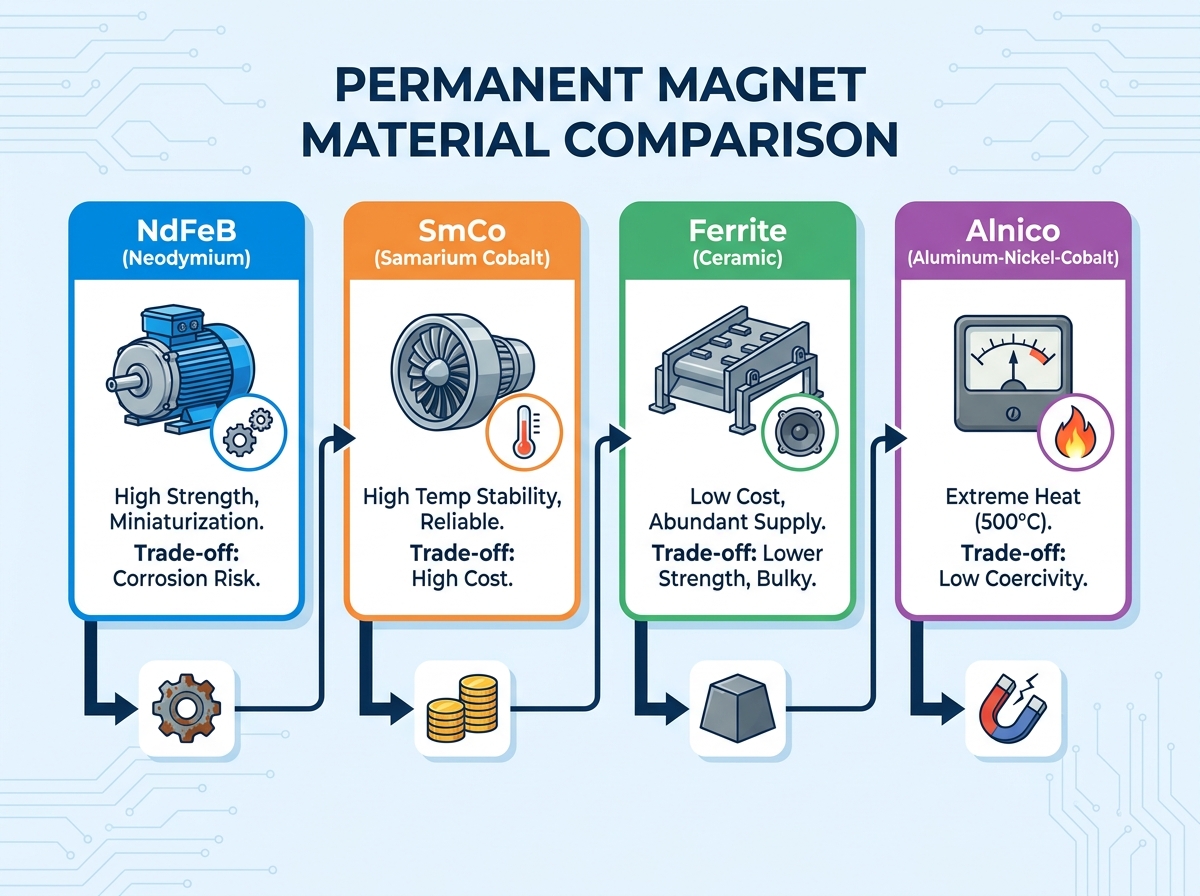
No single magnetic material works perfectly for every industrial application. You must match the material grade to your specific environmental constraints. Engineers typically choose between four primary material categories. Each category offers a unique blend of strengths and weaknesses.
Neodymium Iron Boron (NdFeB)
NdFeB currently dominates the high-performance market. These rare-earth materials deliver unparalleled magnetic strength. They are best for miniaturization projects, high-torque motors, and consumer electronics. The trade-offs, however, require careful management. NdFeB is highly vulnerable to corrosion in humid environments. You must apply protective coatings like nickel or epoxy. They also exhibit lower thermal thresholds compared to other alloys.
Samarium Cobalt (SmCo)
SmCo serves as the premium choice for harsh environments. It is best for aerospace applications, military hardware, and high-temperature industrial motors. SmCo provides exceptional temperature stability and natural corrosion resistance. However, it is an extremely brittle material. It chips easily during assembly. It also ranks as the most expensive option due to raw cobalt pricing.
Ceramic/Ferrite
Ferrite components dominate low-cost manufacturing sectors. They are best for consumer appliances, standard automotive sensors, and basic magnetic separators. The primary advantage is an abundant, inexpensive supply chain. Ferrite components resist corrosion naturally. The trade-off is poor magnetic density. You need physically bulky components to achieve meaningful magnetic strength.
Alnico (Aluminum-Nickel-Cobalt)
Alnico represents one of the oldest magnetic alloys still in use. It is best for legacy industrial equipment and ultra-high-temperature environments. Alnico operates comfortably at temperatures approaching 500°C. It boasts an excellent temperature profile. Unfortunately, it features very low coercivity. External fields can easily demagnetize Alnico components.
Use the following comparison chart to guide your initial material selection process. It outlines the foundational properties of each category.
| Material Type | Relative Strength (BHmax) | Max Operating Temp | Corrosion Resistance | Relative Cost |
| Neodymium (NdFeB) | Highest | 80°C - 230°C | Low (Coating Required) | High |
| Samarium Cobalt (SmCo) | High | 250°C - 350°C | Excellent | Very High |
| Ceramic / Ferrite | Low | 250°C | Excellent | Very Low |
| Alnico | Moderate | Up to 500°C | Good | Moderate |
High-Impact Industrial Applications of Permanent Magnets
The global shift toward energy efficiency relies heavily on magnetic technology. Industries deploy a permanent magnet to solve complex mechanical problems. We see rapid adoption across several high-impact sectors.
Electric Motors and Generators
Electric vehicles (EVs) and wind turbines depend entirely on high-BHmax materials. Neodymium components reduce overall motor weight dramatically. This weight reduction maximizes rotational efficiency and extends EV battery range. Wind turbines utilize massive magnetic arrays to convert kinetic energy into electricity. These systems must operate flawlessly for decades in remote locations.
Industrial Automation and Robotics
Modern factories require pinpoint precision. Robotics engineers use magnetic components in servomotors and linear actuators. These parts deliver immediate torque response for rapid movements. Magnetic sensors provide precise positional feedback to the central control units. This ensures robotic arms move exactly as programmed without mechanical drift.
Material Handling and Magnetic Separation
Recycling facilities and food processing plants face constant contamination risks. They deploy heavy-duty magnetic separators to capture stray ferrous metals. These systems guarantee continuous operation. Because they rely on passive magnetic fields, they never suffer from power failure risks. They protect downstream crushing equipment from catastrophic damage.
Medical Technology
The medical field demands absolute stability and uniformity. Magnetic resonance imaging (MRI) machines require a massive, perfectly calibrated magnetic field. Engineers build these foundational systems using highly stable magnetic alloys. The fields must not fluctuate over time. Any degradation compromises the imaging accuracy and patient diagnostics.
Implementation Risks: Supply Chain, Environment, and Sustainability
Specifying a material grade is only the first step. You must also navigate significant external risks before mass production begins. Procurement teams face a complex landscape of supply chain and environmental hurdles.
The Rare Earth Supply Chain Crisis
The rare earth supply chain is notoriously volatile. Neodymium and Dysprosium are critical for high-performance motors. Geopolitical constraints heavily influence the availability of these elements. A few countries control the majority of raw material processing. This concentration creates drastic price fluctuations. Manufacturers are actively pushing for reduced-heavy-rare-earth (HRE) formulations. Lowering Dysprosium content helps stabilize production costs and secures supply lines.
Environmental Degradation Realities
Your operating environment will actively degrade magnetic performance if left unchecked. You must account for two major environmental realities:
- Thermal Demagnetization: Every magnetic material has a Curie temperature. If operating temperatures exceed safe thresholds, the component suffers irreversible loss. You must specify a material grade rated for your maximum expected heat spikes.
- Corrosion and Oxidation: Humid and chemical environments destroy raw NdFeB quickly. You must implement strict plating requirements. Common solutions include Ni-Cu-Ni triple plating or specialized epoxy coatings. These barriers prevent oxidation from degrading the structural integrity of the component.
Sustainability and Recycling (ESG Integration)
Corporate sustainability goals now dictate procurement strategies. The market demands end-of-life magnet recycling. Companies face intense pressure to meet Environmental, Social, and Governance (ESG) compliance. Relying solely on newly mined rare earths is becoming commercially risky. Engineers are designing assemblies making it easier to extract magnetic materials later. Recycling reduces raw material dependency and lowers the overall environmental footprint.
How to Spec and Source the Right Permanent Magnet
Translating theoretical requirements into a physical product requires rigorous discipline. You cannot rely on guesswork when specifying a permanent magnet for industrial use. Follow a systematic approach to ensure commercial success.
Define Success Criteria
Start by mapping exact operating parameters. You must identify the maximum operating temperatures the assembly will face. Calculate the precise holding force or rotational torque required. Measure your absolute spatial constraints. Only after defining these variables should you select a material grade. Attempting to fit a generic material into a custom application usually fails.
Vendor Vetting and Compliance
Your supply chain is only as strong as your chosen vendor. You must shortlist suppliers using strict compliance metrics. Demand to see valid ISO 9001 or ISO/TS 16949 certifications. These prove the manufacturer maintains rigorous quality control. Require REACH and RoHS compliance documentation for environmental safety. Finally, insist on verifiable magnetic testing data for every batch shipped. Reputable vendors will provide hysteresis graphs routinely.
Prototyping
Never skip the prototyping phase. Begin with magnetic finite element analysis (FEA). FEA software simulates how the magnetic field interacts with your specific steel assembly. It reveals flux leakage and weak points instantly. Once the digital model works, order physical prototypes. You must validate the simulated performance in real-world conditions before committing to mass production.
Conclusion
Specifying a permanent magnet requires a careful balance of competing priorities. You must weigh magnetic strength against thermal stability. You must also align engineering requirements with supply chain security. A high-performance NdFeB part means nothing if your vendor cannot source raw dysprosium. Conversely, a cheap ferrite part fails if it lacks the necessary coercivity for your motor.
Take immediate action to secure your next manufacturing project. Map your spatial constraints and temperature requirements today. Consult with a dedicated magnetic engineering specialist early in your design phase. Download a comprehensive material grade selection guide to finalize your exact technical specifications. Proper planning now prevents catastrophic failures later.
FAQ
Q: What is the difference between an electromagnet and a permanent magnet in industrial applications?
A: An electromagnet requires a continuous electrical current to generate a magnetic field. If power fails, the magnetic force disappears immediately. A permanent magnet generates its own passive magnetic field indefinitely without any external power source. Industry relies on them for fail-safe holding operations and continuous field generation in motors.
Q: Which permanent magnet is best for high-temperature environments?
A: Alnico handles the highest absolute temperatures, operating safely up to 500°C. However, it demagnetizes easily. Samarium Cobalt (SmCo) is generally the best industrial choice. It handles up to 350°C while maintaining excellent resistance to external demagnetizing fields. Standard NdFeB typically fails above 150°C to 230°C depending on the specific grade.
Q: How long do permanent magnets retain their magnetism?
A: Under ideal conditions, they retain their magnetism indefinitely. Microscopic degradation occurs, but they lose only a fraction of a percent of strength per decade. However, immediate and irreversible loss happens if you expose them to temperatures exceeding their thermal limits or subject them to massive opposing magnetic fields.
Q: Can industrial permanent magnets be recycled?
A: Yes. The industry is rapidly developing recycling programs for NdFeB components. Engineers use mechanical crushing and advanced hydrometallurgical processes to extract raw neodymium and dysprosium from end-of-life motors. This reduces environmental impact and mitigates global supply chain shortages for rare earth elements.