Selecting the right magnetic material goes far beyond simply measuring pull force. It requires a precise engineering balance. You must weigh thermal stability against strict spatial constraints. You also need to factor in corrosion resistance and base unit costs. Choosing the wrong material often leads to disastrous field failures. You might experience severe heat-induced demagnetization. Mechanical fracturing during tight-tolerance assembly is another common risk. These errors waste time and drain overall project budgets.
This guide provides a transparent, engineering-focused breakdown of the four primary magnetic materials. We aim to guide your final procurement and design decisions. You will learn how to evaluate key performance metrics accurately. We also detail the specific environmental risks associated with each material type. By following this framework, you can specify the perfect permanent magnet for your exact application requirements. Our goal is ensuring your next assembly performs flawlessly in the field.
Key Takeaways
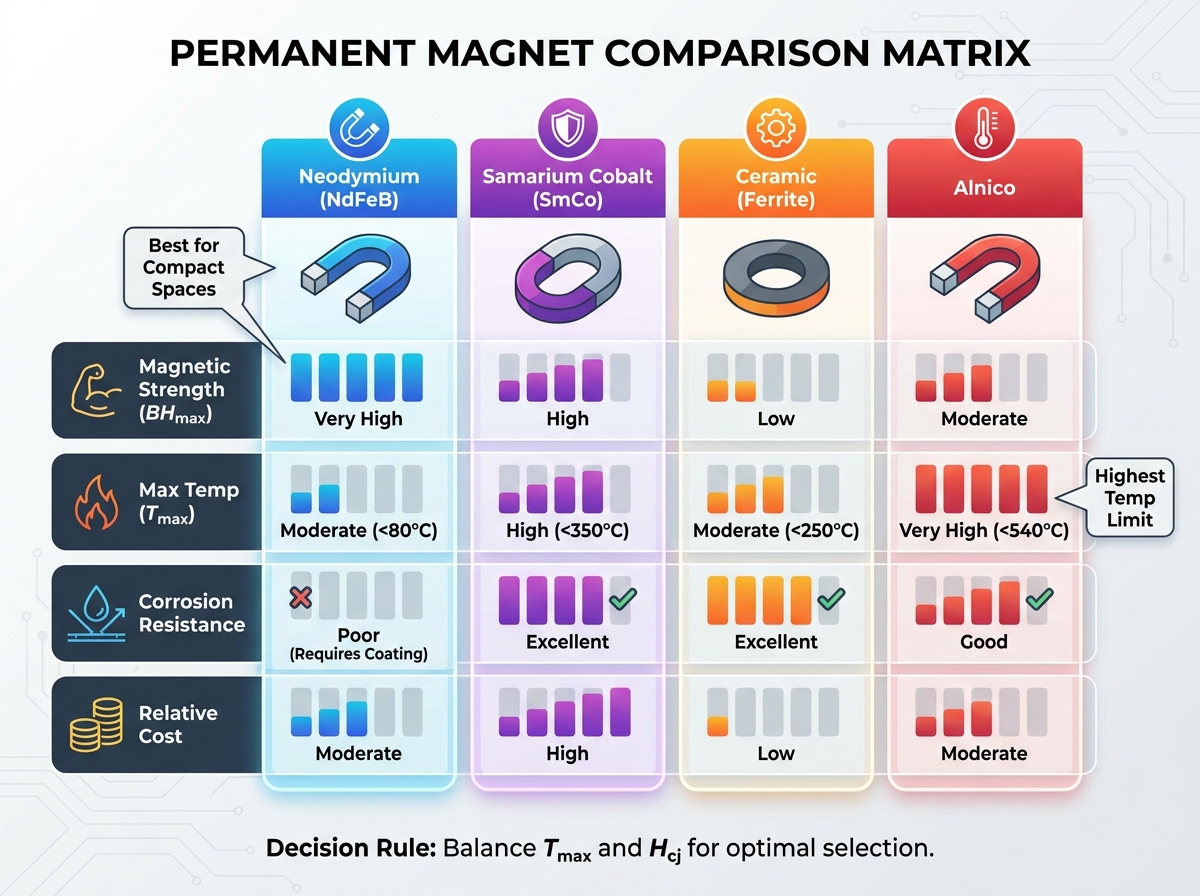
- Neodymium (NdFeB): Highest magnetic strength for compact spaces, but highly susceptible to corrosion and moderate temperature limits.
- Samarium Cobalt (SmCo): Premium rare-earth option offering high strength with exceptional temperature and corrosion resistance; carries a higher price tag and brittleness.
- Ceramic (Ferrite): The most cost-effective and corrosion-resistant option, ideal for large-scale production where size and weight are not primary constraints.
- Alnico: Unmatched high-temperature performance (up to 540°C), but requires careful design to prevent accidental demagnetization.
- Decision Rule: Magnet selection must be driven by Maximum Operating Temperature ($T_{max}$) and Intrinsic Coercivity ($H_{cj}$), not just Maximum Energy Product ($BH_{max}$).
Defining Project Requirements: Essential Evaluation Criteria
Before selecting a specific material, you must understand the underlying metrics governing magnetic performance. Engineers often over-specify magnetic pull while ignoring environmental stability. This imbalance leads to premature component failure. Let us examine the fundamental evaluation criteria you must define during the early design phase.
Maximum Energy Product ($BH_{max}$)
This value serves as the primary indicator of magnetic strength and volume efficiency. We measure it in MegaGauss-Oersteds (MGOe). A higher number means you can achieve the desired magnetic field using a significantly smaller volume of material. If your assembly requires intense power inside a microscopic footprint, you must prioritize materials boasting a high $BH_{max}$. This metric directly dictates the physical dimensions of your final component.
Intrinsic Coercivity ($H_{cj}$)
Intrinsic Coercivity represents the resistance to demagnetization. We typically measure this in Oersteds (Oe) or kiloAmperes per meter (kA/m). External magnetic fields constantly threaten magnetic stability. High ambient heat also degrades internal magnetic alignment. High coercivity proves absolutely critical for electric motors, generators, and proximity sensors. These applications subject the material to strong, repelling magnetic fields daily. A low-coercivity component will rapidly lose its strength under these demanding conditions.
Maximum Operating Temperature ($T_{max}$)
Magnetic strength inevitably degrades as ambient heat rises. Every material has a specific thermal threshold. Crossing this temperature threshold causes irreversible magnetic losses. Your component will not recover its original operational strength upon cooling to room temperature. You must accurately match this thermal rating to the highest expected environmental temperature your product will face. Ignoring this metric guarantees long-term reliability issues.
Rare Earth Permanent Magnets: Neodymium vs. Samarium Cobalt
Rare earth materials dominate the modern engineering landscape. They offer unparalleled power density. However, they also introduce complex environmental and mechanical challenges. We must compare the two primary rare earth options to understand their distinct advantages.
Neodymium (NdFeB) – The High-Strength Standard
Neodymium iron boron currently holds the title for the most powerful commercially available magnetic material. Engineers rely on it heavily for modern product miniaturization.
- Optimal Use Case: You will find these components inside consumer electronics, smartphones, and high-performance servo motors. They excel in any application where extreme miniaturization is strictly required.
- Implementation Risks: The high iron content causes rapid oxidation in humid environments. They require protective surface treatments like Ni-Cu-Ni plating or epoxy coatings. Furthermore, standard grades lose their magnetization above 80°C. You can source specialized high-temperature grades, but they carry a steep premium.
Samarium Cobalt (SmCo) – The Extreme Environment Choice
When environmental conditions become too hostile for Neodymium, engineers turn to Samarium Cobalt. It provides exceptional stability under extreme stress.
- Optimal Use Case: This material dominates aerospace components, downhole drilling sensors, and military-spec equipment. It thrives where failure is simply not an option.
- Implementation Risks: The sintering process leaves this material highly brittle. It easily chips or shatters during aggressive assembly processes. Additionally, raw material costs fluctuate wildly based on global cobalt markets.
- Buyer Note: The inherent corrosion resistance eliminates the need for protective plating. This unique characteristic often offsets some of the higher initial material costs during manufacturing.
Traditional Permanent Magnets: Ceramic (Ferrite) vs. Alnico
Before the rare earth boom, traditional materials built the modern industrial world. They remain incredibly relevant today. They offer excellent cost efficiency and specialized performance characteristics unavailable in newer alloys.
Ceramic/Ferrite – The High-Volume Workhorse
Composed primarily of iron oxide mixed with strontium or barium, ceramic options provide unmatched economic value. They completely resist rust and perform reliably across decades of use.
- Optimal Use Case: We see massive adoption in automotive sensors, loudspeakers, magnetic separators, and household appliances. They rule the high-volume manufacturing sector.
- Implementation Risks: They feature very low magnetic energy. You must allocate a much larger footprint to achieve your desired pull force. They also suffer from poor mechanical tensile strength, making them susceptible to cracking under bending stress.
Alnico – The High-Heat Legacy Material
Named for its composition of Aluminum, Nickel, and Cobalt, this legacy material possesses a unique operational profile. It tolerates heat better than almost any other standard option.
- Optimal Use Case: Engineers specify Alnico for high-temperature industrial handling equipment. It also remains heavily favored in classic audio equipment and highly specialized analog measuring instruments.
- Implementation Risks: These components possess very low intrinsic coercivity. They easily demagnetize if you store them improperly or expose them to repelling fields. Consequently, many designs require you to magnetize the assembly only after final physical construction is complete.
Implementation Risks: Engineering and Assembly Considerations
Selecting the optimal material chemistry represents only the first step. You must successfully integrate this component into your final product. Assembly introduces a host of mechanical and logistical challenges. Proper planning prevents expensive manufacturing delays.
Machining and Fabrication
You cannot machine a fully magnetized component using conventional lathes or mills. The material is far too brittle. Manufacturing custom shapes requires specialized diamond grinding equipment. Furthermore, grinding Neodymium generates highly pyrophoric dust. Operators must use heavy fluid coolant to prevent severe fire hazards and localized demagnetization from friction heat. Always finalize your geometric design before requesting the sintering process.
Coating and Tolerances
Mandatory protective coatings severely impact your final dimensional tolerances. Standard Neodymium requires a triple-layer Nickel-Copper-Nickel plating. This treatment adds several micrometers to the final outer dimensions. If your design utilizes strict interference fits, you must account for this added plating thickness during the CAD drafting phase. Failing to accommodate the coating often leads to shattered components during press-fit operations.
Supply Chain & Compliance
Global supply chains for rare earth materials remain highly volatile. Geopolitical shifts rapidly impact the availability of Neodymium and Samarium Cobalt. Additionally, stringent international regulations govern their use. You must carefully track compliance documentation. Ensure your procurement team verifies all RoHS, REACH, or domestic sourcing requirements before committing to a long-term production contract.
Decision Framework: Shortlisting the Right Permanent Magnet
Navigating the various materials requires a systematic approach. Do not guess or rely purely on unit pricing. Follow this structured engineering framework to narrow down your options efficiently.
Table 1: Magnetic Material Performance Comparison Matrix
| Material Type | Max Energy ($BH_{max}$) | Max Temp Limit | Corrosion Resistance |
| Neodymium (NdFeB) | 35 - 52 MGOe | 80°C (Standard) / 200°C (Special) | Poor (Coating Required) |
| Samarium Cobalt (SmCo) | 16 - 32 MGOe | 250°C - 350°C | Excellent |
| Ceramic (Ferrite) | 1 - 5 MGOe | 250°C | Excellent |
| Alnico | 5 - 9 MGOe | Up to 540°C | Good |
- Step 1: Define the Thermal Envelope. Look at your maximum expected operating temperature. If your application operates above 150°C, you must immediately filter out standard Neodymium. Pivot your focus directly toward Samarium Cobalt, Alnico, or specialized high-temp NdFeB grades.
- Step 2: Assess Spatial Constraints. Evaluate the physical volume available in your assembly. If your design requires a microscopic footprint, default directly to Neodymium or Samarium Cobalt. If physical space is unlimited, pivot immediately to Ceramic to slash your raw material costs.
- Step 3: Evaluate Environmental Exposure. Analyze the ambient humidity and chemical exposure levels. For high moisture or highly corrosive environments, eliminate uncoated Neodymium from your list. Prioritize Ceramic or Samarium Cobalt to prevent catastrophic oxidation.
- Step 4: Prototype and Test. Never jump straight into mass production. We strongly recommend ordering low-volume samples first. Subject these prototypes to rigorous thermal cycling and mechanical pull-testing. Validate the performance before committing capital to high-volume manufacturing tooling.
Conclusion
- There is no single "best" universal magnetic material. You must discover the optimal alloy for your specific operational envelope and project budget.
- Prioritize thermal stability and environmental resistance just as highly as pure magnetic strength.
- Account for assembly limitations, machining restrictions, and coating tolerances early in your design phase.
Your next step requires finalizing your maximum temperature limits and spatial dimensions. Once you lock in these parameters, consult directly with a specialized magnetic engineer. They will help you specify the exact performance grade required, whether that means choosing between an N42 and N52, or selecting the proper SmCo5 versus Sm2Co17 composition. Proper specification guarantees long-term product success.
FAQ
Q: Can a permanent magnet lose its strength over time?
A: Yes, it can degrade under specific conditions. Severe high heat, extreme physical shock, or prolonged exposure to strong opposing magnetic fields will drain its energy. However, under normal, stable conditions, modern materials lose only a negligible fraction of a percent of their overall strength every decade.
Q: Why can't I just drill a hole in a Neodymium magnet?
A: Drilling destroys the component. The friction generates intense heat, permanently demagnetizing the localized area. The bit shatters the brittle crystalline structure. Furthermore, drilling breaks the vital anti-corrosion coating, exposing the iron to rapid oxidation. You must request all custom shapes and holes during the initial manufacturing and sintering process.
Q: Is it cheaper to use a larger Ceramic magnet or a smaller Neodymium magnet?
A: Generally, Ceramic costs significantly less per pound. However, you must evaluate your entire assembly. If choosing the larger Ceramic option forces you to expand the overall product housing, your plastic or metal costs will skyrocket. The smaller Neodymium option allows for compact housing. Miniaturization often offsets the higher material price entirely.