In metal fabrication, profitability remains directly tied to your actual arc-on time. Time spent manually aligning, clamping, and readjusting workpieces equals unbillable labor. This constant inefficiency heavily drains your daily production goals. Traditional C-clamps and locking pliers work well. However, they slow down operators significantly. Welders often struggle manipulating heavy materials. This leads to physical fatigue and frustrating micro-adjustments. Solving these setup bottlenecks fundamentally transforms how fabrication shops handle complex assemblies.
Modern tools have evolved from simple static magnets. They now exist as highly engineered, switchable fixturing devices capable of holding massive payloads. We will explore specific use cases, operational limitations, and practical strategies. You will learn exactly how to evaluate these upgrades effectively before retooling your entire fabrication shop.
Key Takeaways
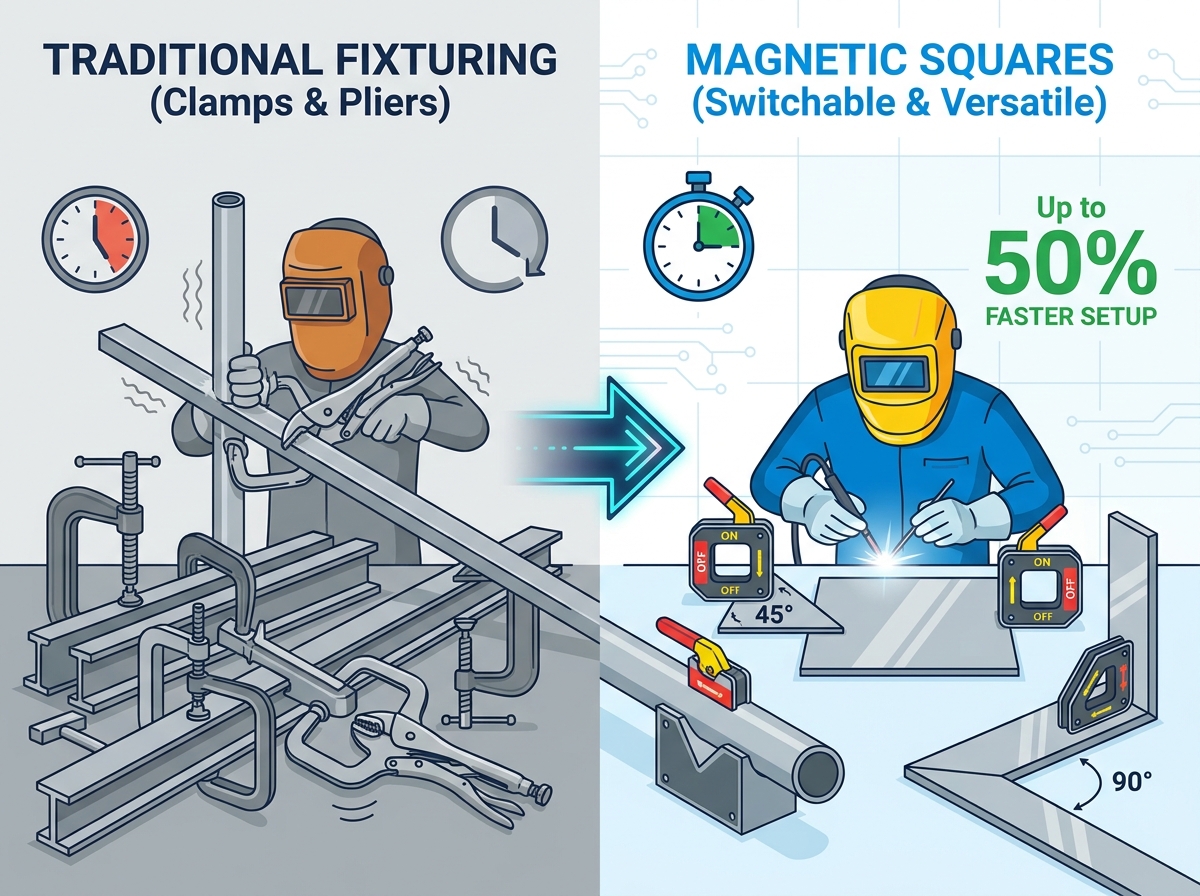
- A high-quality magnetic square reduces setup and fixturing time by up to 50% compared to traditional mechanical clamping.
- The primary magnetic square applications include multi-angle tack welding, pipe fitting, and sheet metal alignment.
- Not all magnets are created equal; evaluating hold force, maximum heat tolerance, and switchability (ON/OFF functionality) is essential for industrial welding environments.
- Implementation requires awareness of risks, specifically heat degradation and magnetic arc blow during TIG/MIG welding.
The Business Case: Why Fabricators are Upgrading Fixturing Workflows
The hidden costs of mechanical fixturing often go unnoticed by management. Operators suffer fatigue clamping parts repeatedly. Two-handed setups demand intense concentration. Welders constantly make tiny micro-adjustments. These redundant actions consume valuable shop hours. They drain human energy and reduce overall daily output. Modern fixturing tools eliminate this unnecessary physical struggle entirely. A welder can securely lock a heavy gusset into place instantly using just one hand.
Rigid fixturing prevents severe thermal distortion. The initial tacking phase introduces massive localized heat. Unsecured metal pulls and warps instantly. Warped frames require expensive downstream rework. Fabricators must cut tacks and realign warped parts. Strong holding power keeps joints perfectly rigid. The metal cannot move during the rapid cooling phase. This eliminates tedious rework processes completely.
Traditional fabrication relies heavily on single-purpose jigs. Shops spend weeks building custom fixtures. These jigs only serve one specific product line. Custom and low-volume production runs suffer greatly under this rigid model. Versatile blocks solve this scalability issue instantly. They adapt quickly to unique geometries. You deploy them across completely different projects daily. This adaptability maximizes shop floor productivity.
Top 5 Magnetic Square Applications in Metal Fabrication
Fabricators utilize these versatile tools across numerous challenging scenarios daily. When exploring various Magnetic square applications, multi-angle tack welding stands out prominently.
Application 1: Multi-Angle Tack Welding
Multi-angle tack welding forms the foundation of robust frame assembly. Fabricators utilize standard 45-degree, 90-degree, and 135-degree angles frequently. These precise angles guarantee perfectly square joints.
Outcome: A single operator holds heavy stock square effortlessly. They complete the tacking process independently. This entirely eliminates needing a second set of hands. Labor efficiency doubles immediately.
Application 2: Pipe and Tube Fitting
Round materials present unique clamping challenges constantly. Fabricators solve this using specialized tools featuring V-groove channels. These channels center cylindrical stock precisely. They hold tubes securely against flat steel plates.
Outcome: The magnetic grip prevents unwanted rolling entirely. It ensures perfect saddle joints forming. Welders achieve optimal fit-up prior to executing critical root passes.
Application 3: Sheet Metal Squaring and Alignment
Warped sheet metal frustrates welders constantly. Gaps between sheets cause severe burn-through. Operators deploy heavy-duty tools to solve this problem. The intense pull draws warped sheet metal flush. It forces the sheet against structural frames securely.
Outcome: This process reduces joint gaps perfectly. It ensures optimal weld penetration. Welders minimize expensive filler metal waste significantly.
Application 4: Temporary Workholding for Drilling and Grinding
Drilling heavy plate requires extreme workpiece stability. Fabricators anchor gussets or brackets firmly into place. They execute precision drilling tasks safely. They avoid building complex vise setups completely.
Outcome: This technique enhances operator safety tremendously. It replaces dangerous manual holding practices. Consistent, high-breakaway-force gripping secures the metal entirely.
Application 5: Precision Layout and Inspection
Accurate fabrication begins during the layout phase. Workers use true-machined blocks as physical reference points. They apply layout fluid markings precisely. They execute scribing and squaring checks efficiently.
Outcome: The rigid block maintains incredibly tight tolerances. It guarantees dimensional accuracy before any cutting begins. High precision eliminates downstream assembly failures completely.
Evaluating a Magnetic Square for Welding: Features to Outcomes
Before purchasing a Magnetic square for welding, fabrication managers must analyze several technical specifications carefully.
Constant magnets attract ferrous dust continuously. Grinding dust coats the surfaces entirely. They become incredibly difficult to clean. Modern switchable models operate entirely differently. You turn the internal cylinder off. The internal magnetic field collapses completely. Trapped metal shavings fall away instantly. This preserves mating surface accuracy perfectly.
The Magnet Technology Comparison Chart below highlights operational differences.
| Technology Type | Cleaning Process | Surface Accuracy Retention | Ideal Environment |
| Constant | Manual scraping required | Degrades if debris builds up | Clean, dust-free zones |
| Switchable | Debris falls away instantly | Remains perfectly flat | Heavy industrial grinding areas |
Clarifying manufacturer claims prevents workplace accidents. Manufacturers often advertise breakaway force. A 150-pound breakaway force does not equal a 150-pound shear force. Shear force measures sliding resistance downward. It usually equals half the breakaway rating. You must evaluate ratings based on exact metal thickness. Surface conditions like mill scale or rust also reduce holding power significantly.
The Surface Condition Hold Force Derating Chart illustrates expected performance drops.
| Surface Condition | Effective Breakaway Hold Capacity | Effective Shear Hold Capacity |
| Clean, thick milled steel | 100% of rated capacity | 50% of rated capacity |
| Heavy mill scale presence | 70% of rated capacity | 35% of rated capacity |
| Painted or rusted surface | 50% of rated capacity | 25% of rated capacity |
| Thin sheet metal (under 1/8 inch) | 40% of rated capacity | 20% of rated capacity |
Welding generates extreme localized heat. Standard neodymium components lose strength at approximately 175°F (80°C). Fabricators must specify high-heat rated models for heavy structural work. Proper placement away from the direct Heat Affected Zone (HAZ) remains absolutely crucial. Excessive heat causes permanent demagnetization. Ruined tools offer zero holding power.
Implementation Realities & Safety Considerations
Strong magnetic fields deflect the welding arc easily. This happens frequently during DC TIG or Stick welding. The arc wanders away from the joint line. It causes poor penetration and ugly welds. Mitigation strategies require specific workflows. Follow these exact steps to prevent arc blow:
- Ground the workpiece properly far away from the active fixture.
- Tack the structural joint securely at multiple strategic points.
- Turn off the switchable device completely.
- Remove the tool entirely before starting continuous weld passes.
Buyers must remember specific material constraints always. These tools prove entirely useless on austenitic stainless steels. The 300 series stainless rejects magnetism completely. Aluminum also provides zero magnetic attraction. Always test scrap material first.
Keep all machined contact points perfectly clean. Spatter buildup destroys precise 90-degree tolerances. Grinding dust causes similar alignment failures. Wipe down surfaces daily. Store tools inside dry, enclosed cabinets. Proper maintenance guarantees years of reliable service.
Shortlisting Logic: Which Magnetic Square Fits Your Shop?
Finding the ideal Magnetic Square requires matching tool capabilities to your specific shop environments.
Arrow-style, non-switchable constant magnets fit smaller budgets well. They offer low cost entry points. However, they require frequent cleaning. They also provide lower overall precision. They suit light-duty hobbyist projects perfectly.
Switchable, enclosed tools dominate heavy industry. Magswitch-style technology leads this sector. They require higher upfront investments. Yet, they offer massive return on investment daily. Setup speed and operator safety improve drastically.
Audit your current setup times carefully today. Ask yourself the following critical questions:
- Does fixturing take longer than actual welding operations?
- Do you build highly repetitive assemblies daily?
- Are operators struggling to hold heavy plates manually?
If you answered yes, prioritize a pilot test immediately. Deploy two heavy-duty switchable models onto your busiest workbench. Measure the resulting time savings carefully.
Conclusion
Integrating these modern tools modernizes workflow efficiency completely. You achieve faster, more accurate setups instantly. It moves beyond simply buying another hand tool. It transforms your entire fabrication process. Balance the upfront investment of premium switchable models carefully. Weigh this initial cost against daily labor savings. Consider the dramatic reduction in downstream rework. Smart fixturing decisions guarantee better fabrication outcomes.
FAQ
Q: Will a magnetic square affect my welding arc?
A: Yes. Strong magnetic fields can cause severe arc blow. This occurs most frequently in DC TIG and Stick welding. The magnetic pull deflects the arc path away from the root joint. To avoid this entirely, use the tool strictly for initial fit-up. Tack the metal securely first. Turn off the device and remove it. Once removed, you can weld the root pass safely.
Q: Can magnetic squares be used on stainless steel?
A: It depends entirely on the exact stainless steel grade. Ferritic and martensitic stainless steels contain iron. Magnets stick to them easily. However, austenitic stainless steels, like the popular 300 series, remain completely non-magnetic. Tools will not hold these materials securely. Always test your specific metal batch before planning a complex fixturing setup.
Q: How do you clean spatter off a magnetic square?
A: Switchable models clean up effortlessly. When you turn the dial off, the magnetic field drops to zero. Most ferrous debris falls away naturally. For stubborn spatter, use a soft brass brush. You can also apply anti-spatter sprays carefully on fully sealed units. Never grind directly over the tool. Fine grinding dust damages internal mechanisms quickly.
Q: What is the difference between breakaway force and safe working load?
A: Breakaway force measures the exact weight required to pull the magnet straight off a thick, flat steel plate. It represents absolute maximum holding power under perfect laboratory conditions. Safe working load accounts for real-world fabrication variables. These include thin metals, rust, and shear sliding forces. Fabricators should strictly apply a 3:1 or 2:1 safety factor to manufacturer ratings.