Selecting the right permanent magnet for industrial applications requires balancing magnetic strength against harsh environmental realities. The wrong material choice leads to rapid demagnetization, catastrophic product failure, or unnecessary project costs. You need absolute precision in your selection, not just raw power.
This guide bridges the gap between strict engineering specifications and daily procurement realities. It provides a reliable framework to properly evaluate different materials, protective coatings, and supplier capabilities. You can successfully avoid common pitfalls when sourcing these critical industrial components.
Our goal is to equip procurement managers and design engineers with highly objective criteria. We will help you shortlist, specify, and source industrial-grade magnetic materials with total confidence. You will learn exactly how to align physical properties against real-world manufacturing demands.
Key Takeaways
- Material dictates limitation: Neodymium offers peak strength, but Samarium Cobalt (SmCo) is mandatory for high-heat/corrosive environments.
- Look beyond pull force: Coercivity (resistance to demagnetization) and Maximum Operating Temperature (Tmax) are equally critical evaluation metrics.
- Coatings are not optional for NdFeB: Specific industrial environments require targeted plating (e.g., Ni-Cu-Ni vs. Epoxy) to prevent rapid oxidation.
- Supplier vetting mitigates supply chain risk: Prioritize vendors with transparent testing protocols, ISO/IATF certifications, and RoHS/REACH compliance.
Aligning Permanent Magnet Materials with Industrial Constraints
Different industrial environments demand very specific magnetic properties. You cannot apply a simple one-size-fits-all approach. Choosing the incorrect base material guarantees premature system failure. We must carefully match material traits against your exact operational limits.
Neodymium (NdFeB)
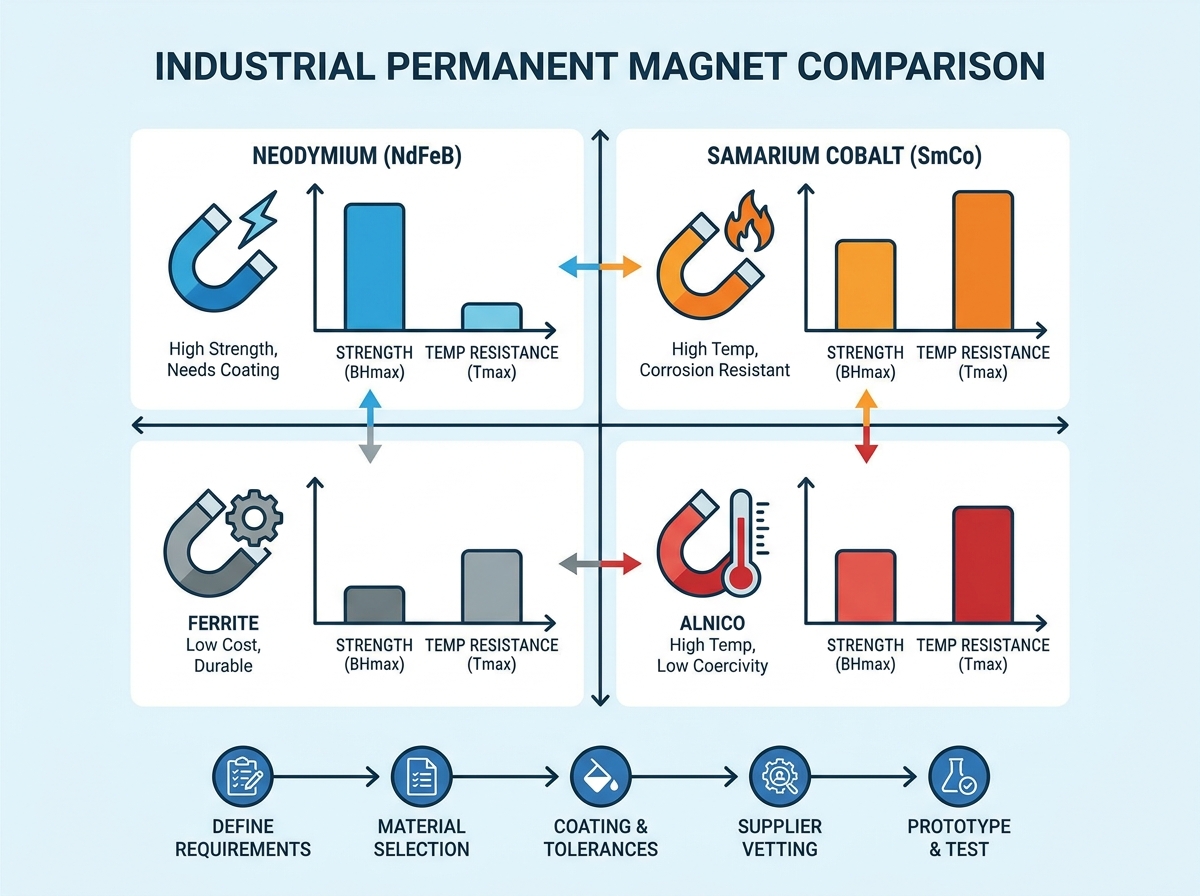
Engineers primarily specify Neodymium for high-performance motors, compact sensors, and advanced robotics. It offers the highest energy product (BHmax) available today. It delivers incredible pull force in a very small physical footprint.
However, reality checks are necessary. NdFeB corrodes rapidly in untreated states. You must apply robust coatings to prevent destructive oxidation. Standard grades also degrade quickly in hot environments. You will need specialized high-grade variations like "SH" or "UH" grades. These targeted variations survive operating conditions above 80°C.
Samarium Cobalt (SmCo)
Aerospace, military hardware, and high-speed motor applications heavily rely on Samarium Cobalt. It handles extreme conditions beautifully.
This material comes at a higher cost. It also exhibits a highly brittle nature. However, it provides unparalleled temperature stability. SmCo operates flawlessly up to 350°C. It also boasts native corrosion resistance. You do not need secondary plating to protect it from moisture.
Ferrite (Ceramic)
Industrial conveyor systems, basic separation equipment, and standard automotive sensors use Ferrite materials. It represents the workhorse of basic industrial design.
Ferrite has relatively low magnetic strength. Despite this, it remains highly cost-effective and easily scalable for mass production. It resists corrosion naturally. It also features a strong resistance to demagnetization from external fields.
Alnico (Aluminum Nickel Cobalt)
Legacy instruments and high-temperature sensors still utilize Alnico components. This older technology serves very niche, high-heat applications today.
Alnico boasts excellent temperature coefficients. It functions securely up to a staggering 540°C. Unfortunately, it suffers from very low coercivity. This makes it highly susceptible to accidental demagnetization. Improper handling or clumsy assembly easily degrades its internal magnetic field.
Permanent Magnet Material Comparison Chart
| Material Type | Peak Strength (BHmax) | Max Operating Temp (Tmax) | Corrosion Resistance | Relative Cost |
| Neodymium (NdFeB) | Highest (up to 52 MGOe) | 80°C to 230°C (Grade dependent) | Very Low (Coating Required) | Medium - High |
| Samarium Cobalt (SmCo) | High (up to 32 MGOe) | 250°C to 350°C | Excellent | Very High |
| Ferrite (Ceramic) | Low (up to 5 MGOe) | 250°C | Excellent | Low |
| Alnico | Medium (up to 9 MGOe) | Up to 540°C | Good | Medium |
Core Evaluation Dimensions for Technical Procurement
Procurement teams must evaluate several technical dimensions carefully. Raw pull force rarely tells the whole operational story. You need a nuanced understanding of internal magnetic metrics, physical manufacturing tolerances, and rigid thermal limits.
Magnetic Performance Metrics
Engineers look at Remanence (Br) first. This represents the residual magnetic flux inside the material. A higher Br value equals a substantially stronger magnetic field. It dictates the raw lifting power or torque generation.
Intrinsic Coercivity (Hcj) is equally vital. It measures the material’s ability to resist demagnetization. External magnetic fields and excessive heat constantly threaten the magnetic alignment. High Hcj values are absolutely crucial for demanding motor applications.
Dimensional Tolerances & Machining
You must rigorously assess the standard dimensional tolerances. Typical precision ranges fall between +/- 0.1mm to +/- 0.05mm. Tighter tolerances drive up production costs significantly.
You must account for the brittle nature of these materials. Complex geometries require highly expensive diamond grinding techniques. Standard cutting tools will simply shatter the block. This specialized machining heavily impacts your final unit economics.
Thermal Degradation Limits
Designers must distinguish clearly between Maximum Operating Temperature (Tmax) and Curie Temperature (Tc). Tmax indicates the highest safe continuous working temperature. Tc marks the point where all magnetic properties vanish permanently.
Operating any system near Tmax requires irreversible loss calculations. You must perform these calculations early during the design phase. Ignoring thermal degradation leads directly to premature equipment failure.
Implementation Risks: Coatings, Assembly, and Safety
Selecting the raw material solves only half your engineering problem. Integrating a permanent magnet into an assembly introduces unique manufacturing risks. You must actively manage corrosion, physical assembly hazards, and severe safety protocols.
Corrosion Mitigation
Untreated NdFeB turns into useless powder under high humidity. You must apply the correct surface treatment. Standard Nickel-Copper-Nickel (Ni-Cu-Ni) plating works well for mostly dry, indoor environments.
Harsh environments demand tougher solutions. You should compare standard plating against Epoxy or Teflon coatings. High-moisture areas or direct chemical exposure require these thicker polymer barriers. They prevent moisture from reaching the sensitive base material.
Assembly Hazards
Manufacturing floors face serious chipping and cracking risks during manual assembly. Strong components possess tremendous attraction forces. If they snap together unexpectedly, they will shatter instantly.
This shattering causes severe yield loss on the production line. Worse, it creates immediate safety hazards. High-velocity shrapnel easily injures assembly technicians. You must implement strict handling jigs to control these attraction forces safely.
Handling & Storage Protocols
Your production environment requires specific safety adaptations. You must outline a comprehensive handling strategy for your workforce.
- Provide completely non-magnetic tooling (like titanium or beryllium copper) for all assembly stations.
- Install localized magnetic shielding during factory transit to prevent accidental collisions.
- Enforce strict pacemaker and medical device safety protocols across the entire factory floor.
- Store bulk inventory in isolated, heavily padded shipping containers until needed.
Supplier Compliance and Supply Chain Scalability
Your chosen vendor acts as a critical extension of your manufacturing line. Poor supplier oversight introduces massive hidden risks. You must evaluate their quality assurance standards, regulatory compliance, and raw material sourcing stability.
Quality Assurance Standards
Never accept components without verifiable testing documentation. You should require complete B-H curve testing data for every single shipped batch. This proves the material meets your specified magnetic grade.
Request detailed salt-spray test reports to verify coating thickness and integrity. Furthermore, you must verify their manufacturing certifications. Look for ISO 9001 for general manufacturing. Demand IATF 16949 certification for any automotive applications.
Regulatory Compliance
Global markets enforce strict environmental directives. Ensure the supplier strictly adheres to RoHS and REACH regulations. These directives limit hazardous heavy metals in your supply chain.
European markets are particularly unforgiving regarding compliance failures. A non-compliant shipment can halt your entire product distribution. Documented compliance protects your company from severe legal and financial penalties.
Raw Material Volatility
Evaluate the vendor's overall sourcing transparency carefully. Rare earth materials, including Neodymium (Nd), Dysprosium (Dy), and Praseodymium (Pr), face ongoing geopolitical supply constraints.
You must openly assess the supplier's inventory buffering models. Ask how they manage sudden pricing volatility. A strong vendor holds strategic raw material reserves. This buffering protects your production timeline from sudden global shortages.
Shortlisting Logic and Lifecycle Reliability
Smart procurement looks beyond the initial purchase order. You must balance upfront pricing against long-term reliability. A structured shortlisting logic ensures you avoid costly redesigns later.
Cost vs. Lifecycle Reliability
Cheaper material grades save upfront budget costs. However, they drastically increase warranty claims if they demagnetize in the field. A failed sensor in a massive industrial machine costs thousands to replace.
Always calculate your component choices based on a robust 5-to-10-year operational lifecycle. Spending twenty cents more on a higher temperature grade often prevents massive downstream warranty losses. Reliability always outpaces initial savings.
Standard Off-the-Shelf vs. Custom Engineering
Custom shapes look appealing on engineering drawings. They are rarely necessary for early testing. You should use standard off-the-shelf shapes like blocks, discs, or rings for early prototyping.
You should only shift to custom geometries when production volume truly justifies the investment. Custom assemblies require expensive initial tooling. They also extend lead times significantly. Keep designs standardized whenever possible to protect your supply chain speed.
The Prototyping Step
You must never skip functional prototyping. Theoretical calculations often miss subtle environmental variables. Follow a strict physical validation sequence:
- Request physical material samples in the exact intended grade and coating.
- Test the actual physical pull force within your unique mechanical assembly.
- Expose the prototype to peak operational heat to test thermal tolerance.
- Assess the manual assembly viability under actual factory working conditions.
Complete these steps before committing to mass production. This sequence eliminates costly surprises during the final manufacturing rollout.
Conclusion
Sourcing a reliable permanent magnet is an exercise in rigorous risk management and precise engineering alignment. It involves much more than simply finding the strongest material available. You must balance thermal limits, physical fragility, and long-term supply chain stability.
We encourage buyers to compile all thermal, spatial, and environmental requirements carefully. Place these details into a comprehensive Request for Quote (RFQ). Clear communication eliminates vendor guesswork.
Take proactive steps today to secure your design. Consult with our experienced magnetic design engineers to review your schematics. You can also request a comprehensive material sample kit to validate your application requirements immediately.
FAQ
Q: How do I choose between N42 and N52 neodymium magnets?
A: You must address the trade-off between peak strength and temperature resistance. N52 offers maximum pull force but degrades at lower temperatures. N42 sacrifices some peak strength but handles heat better. Choose N52 for maximum power at room temperature. Choose N42 if your device generates moderate operational heat.
Q: Does machining a permanent magnet destroy its magnetic field?
A: Yes, if done incorrectly. Post-magnetization machining generates intense friction and heat. This localized heat quickly causes irreversible demagnetization. Machining must be completed before the final magnetization process. If resizing is absolutely necessary, you must use heavy coolant and specialized diamond tools.
Q: How long does a permanent magnet last?
A: Barring extreme heat, severe physical damage, or exposure to opposing magnetic fields, they last indefinitely. Materials like NdFeB and SmCo lose less than 1% of their magnetic flux over a standard 10-year span. They are functionally permanent under normal operational conditions.
Q: What is the standard lead time for custom permanent magnets?
A: You should set realistic expectations for custom designs. Typically, lead times run between 4 and 8 weeks. This timeline depends heavily on raw material availability and specific custom tooling requirements. Standard shapes often ship much faster from existing supplier inventory.