Specifying Custom magnets is a high-stakes engineering decision. A miscalculation in grade, coating, or tolerance can lead to premature demagnetization, mechanical failure, or unnecessary project costs. The N40 grade represents a highly efficient middle ground for modern engineers. It offers significantly more pull force than N35 without the premium cost and temperature fragility of N52. However, transitioning from a standard off-the-shelf magnet to a custom-engineered solution requires strict evaluation criteria. We must assess physical geometries, environmental exposure, and magnetic alignment perfectly before locking in a physical design.
This guide provides a technical and commercial framework for defining your exact magnetic specifications. You will learn how to secure the ideal Custom N40 Magnet for your specific assembly needs. By analyzing thermal limits, evaluating protective coatings, and setting realistic dimensional constraints, you can design magnetic circuits that yield exact, repeatable field performance every single time.
Key Takeaways
- Grade Validation: Standard N40 provides an optimal cost-to-performance ratio, but applications exceeding 80°C require specific high-temperature suffixes (e.g., N40H, N40SH).
- Environmental Protection: Custom shapes and impact risks dictate coating choices; standard Ni-Cu-Ni may fail where Epoxy or specialized plating is required.
- Design Reality: Tighter tolerances (below ±0.05mm) exponentially increase machining costs and lead times.
- Supplier Diligence: A qualified custom magnet manufacturer must provide verifiable B-H curves, magnetic flux consistency reports, and clear supply chain traceability.
Is a Custom N40 Magnet the Right Baseline for Your Application?
Framing the decision requires looking far beyond basic product descriptions. You must compare N40 against alternative Neodymium (NdFeB) grades based on specific metric values. Evaluate Remanence (Br) and Coercivity (Hcj) rather than relying on generic "strength" claims. Remanence measures the residual magnetic flux density remaining in the material. It tells you how strong the magnetic field will be in a closed circuit. Coercivity measures the material's inherent resistance to demagnetization. It dictates how well the magnet withstands external magnetic fields and physical stress.
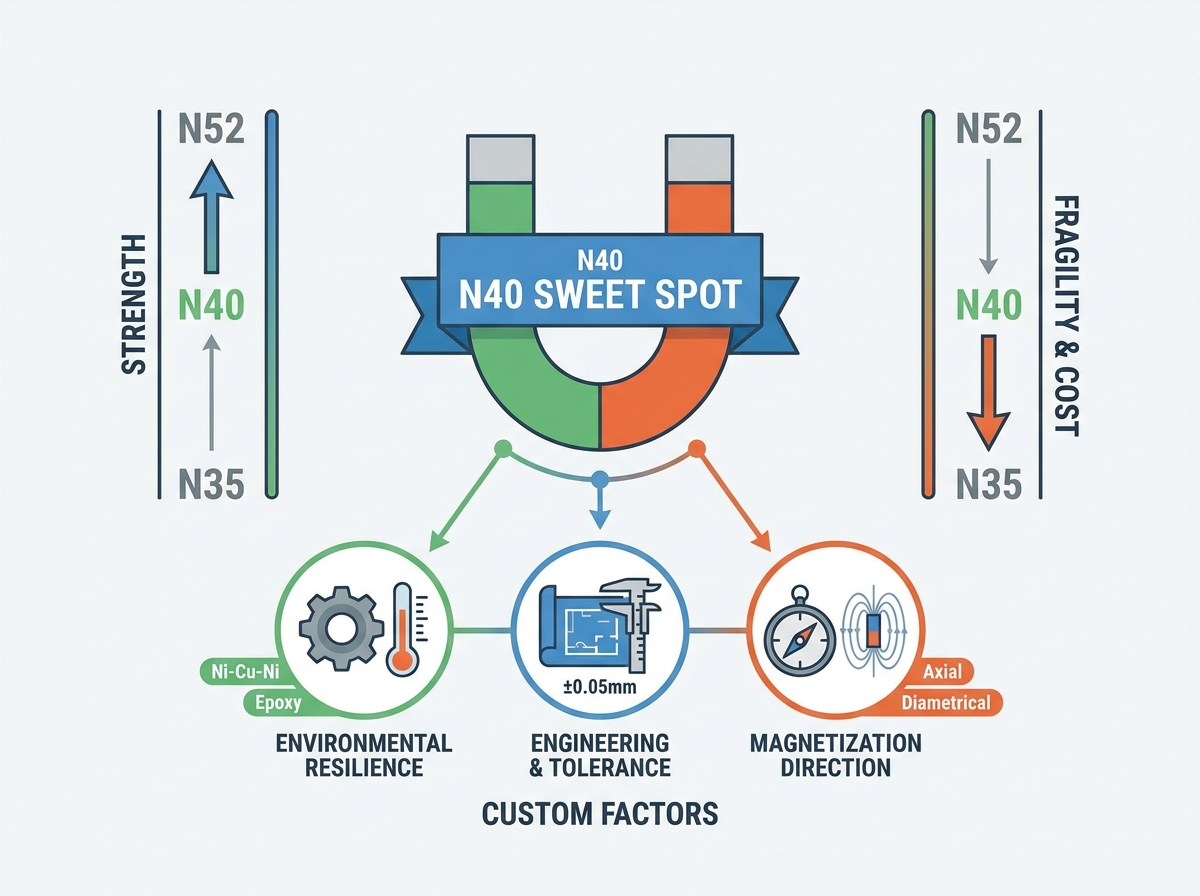
Engineers consistently specify N40 for a very distinct operational sweet spot. It delivers approximately 10-15% more magnetic energy than baseline N35. It achieves this performance boost while remaining highly stable. This balance makes it highly attractive for volume production. You gain a measurable boost in holding force and sensor actuation range. Most importantly, you do not incur the extreme raw material premiums associated with ultra-high grades like N50 or N52.
However, we must acknowledge strict physical limitations. A standard N40 component is not suitable for ultra-compact spaces where maximum flux density is mandatory. In tight micro-assemblies, N52 often becomes necessary to achieve the target field strength. Furthermore, standard N40 is completely unviable in high-heat industrial environments. It lacks the modified intrinsic coercivity required to survive excessive thermal exposure without losing performance.
Establishing concrete success criteria prevents expensive mistakes during the prototyping phase. Document your exact holding force requirements before requesting a tooling quote. Measure your required air gap dimensions carefully. You must also account for opposing magnetic fields near the final installation site. Confirming N40 meets these baseline criteria ensures you do not waste capital on improper custom tooling.
Defining Environmental Resilience and Temperature Thresholds
Many engineers fall into a common and costly temperature trap. Standard N40 magnets suffer irreversible flux loss above 80°C (176°F). The internal magnetic dipoles lose their alignment permanently. This degrades motor efficiency and ruins sensitive hall-effect sensor accuracy. You must map out your application's thermal profile carefully. If the operating environment spikes above this 80°C limit, you must follow a clear decision path. Specify high-temperature variants immediately. Use N40H for environments reaching up to 120°C. Upgrade to N40SH if your assembly peaks around 150°C.
Surface protection matters just as much as internal thermal stability. Uncoated neodymium oxidizes rapidly when exposed to ambient air. We must mitigate corrosion and mechanical chipping through proper coating selection. Review this coating selection matrix to match exterior finishes to your specific operational environment.
| Coating Type | Primary Advantages | Common Application Scenarios | Vulnerabilities |
| Nickel-Copper-Nickel (Ni-Cu-Ni) | Industry standard, highly durable surface, visually reflective. | Indoor assemblies, enclosed motors, consumer electronics. | Susceptible to chipping under hard, repetitive mechanical impacts. |
| Epoxy Resin | Superior moisture barrier, excellent chemical and salt resistance. | Marine environments, high-humidity zones, medical devices. | Thicker coating profile can marginally impact ultra-tight air gaps. |
| Zinc Plating | Highly cost-effective, provides adequate baseline oxidation protection. | Low-humidity settings, internal structural hardware mounts. | Poor performance in highly corrosive, acidic, or wet environments. |
Custom shapes introduce serious implementation risks during the plating phase. Complex geometries often create sharp, 90-degree edges. Electroplating naturally deposits thinnest along these exact intersections. Sharp edges chip easily during automated handling or manual assembly. Factoring in minimal edge chamfering during your initial CAD design prevents catastrophic coating failure. A simple mechanical chamfer allows the plating to distribute evenly. It physically protects the brittle NdFeB material from fracturing under pressure.
Engineering the Custom Form Factor: Shape, Tolerance, and Magnetization
Translating project needs into physical forms dictates the final manufacturing process. You must match the physical shape to your specific magnetic circuitry perfectly. Structural mounting applications often demand countersunk rings to accommodate standard screws. High-performance motor rotors require specialized, precisely calculated magnetic arcs. Advanced positional sensors rely on ultra-thin geometric blocks. Each complex geometry impacts raw material waste significantly. Slicing complex arcs from a sintered master block creates unusable offcuts. Greater raw material waste increases your final unit price. We always recommend keeping physical designs as simple as your application allows.
Tolerance realities often shock uninitiated component buyers. Standard commercial tolerances hover around ±0.1mm. This margin satisfies most mechanical assemblies and general structural holds. Specifying ±0.05mm or tighter creates a compounding manufacturing challenge. You must understand how tight tolerances impact shop floor production:
- Specialized Grinding: Extreme precision requires secondary diamond-grinding processes that consume extra energy and labor.
- Lower Yield Rates: Tighter margins increase the number of rejected parts during automated quality control.
- Extended Lead Times: Extra machining and detailed inspection phases delay final shipment dates significantly.
- Cost Escalation: The combination of raw scrap and specialized labor multiplies the individual component price.
Avoid over-tolerancing non-critical dimensions. Apply tight tolerances exclusively to functional mating surfaces or press-fit diameters.
Magnetization direction defines how the magnetic field interacts within your assembly. You must define this exact alignment prior to manufacturing. Common alignments include Axial, Diametrical, and custom Multipole configurations. Misaligned magnetization makes a dimensionally perfect component completely useless. For example, a diametrically magnetized sensor magnet will fail entirely if your hall-effect sensor requires an axial field. Detail the intended magnetic orientation clearly on all technical drawings. Do not leave this parameter open to vendor interpretation.
Vetting and Selecting a Custom Magnet Manufacturer
Choosing the right production partner ensures your assembly functions reliably over time. Do not evaluate potential suppliers based solely on the lowest quote provided. Raw material purity dictates long-term magnetic performance. Cheap rare-earth blends degrade faster under operational stress. Impurities inside the alloy lower the actual intrinsic coercivity. A qualified Custom magnet manufacturer prioritizes consistent, high-purity alloy composition. They buy high-grade dysprosium and neodymium to ensure batch-to-batch stability.
Prototyping and scalability represent critical evaluation dimensions. Can the manufacturer seamlessly transition from rapid 50-piece prototypes to 100,000-piece production runs? Some shops excel at small-batch custom machining but fail entirely at scale. They must maintain consistent magnetic properties across massive production volumes. Ask about their automated pressing, sintering capabilities, and internal quality control infrastructure.
Quality assurance and regulatory compliance build necessary trust factors. Demand verifiable test data from your supplier before signing any long-term contracts. Request Helmholtz coil testing data to verify the total magnetic moment. Ask for Gaussmeter readings outlining exact surface field strength. You should also review 72-hour salt-spray test results for their epoxy or nickel coatings. Furthermore, examine their institutional quality certifications. Look for ISO 9001 to ensure baseline process control. If you operate in the automotive sector, TS16949 compliance is strictly non-negotiable.
Apply strict shortlisting logic during your vendor search. Partner with a supplier who actively challenges your initial design. They should ask probing questions about your end-use environment. If they accept a highly complex, tight-tolerance N40 specification without requesting operational details, consider it a massive red flag. A reputable engineering team will offer a Design for Manufacturability (DFM) review immediately. They will point out unnecessary tight tolerances. They will recommend better edge chamfering to improve long-term coating adhesion.
Conclusion
Sourcing the right custom N40 magnet requires balancing magnetic output with crucial thermal stability. You must establish realistic machining tolerances and select highly durable surface coatings. Carefully review the environmental limits and exact coercivity requirements before finalizing your grade selection. Skipping these foundational engineering steps frequently leads to premature field failures.
Take immediate action before requesting a formal RFQ. Finalize your 2D and 3D CAD files meticulously. Detail all physical dimensions, acceptable tolerance bands, and required surface coatings. Clearly mark the exact magnetization direction on every single technical drawing. Finally, approach vetted manufacturers for a comprehensive DFM consultation. This upfront collaboration validates your engineering assumptions and secures long-term assembly success.
FAQ
Q: What is the minimum order quantity (MOQ) typical for custom N40 magnets?
A: MOQs vary significantly by manufacturer. Custom tooling usually dictates minimum orders ranging from 500 to 5,000 units. Creating dedicated pressing molds and programming slicing equipment requires this volume to offset setup labor. However, specialized engineering suppliers frequently offer lower-volume rapid prototyping. You can often secure 50 to 100 pieces for initial proof-of-concept testing before committing to a full production run.
Q: How much stronger is an N40 magnet compared to an N35?
A: N40 typically offers a Maximum Energy Product (BHmax) of 38-41 MGOe. This represents roughly a 10-14% increase in overall magnetic performance over standard N35. Assuming identical physical dimensions, the N40 variant will project a denser magnetic field. It delivers noticeably higher pull force. This makes it an ideal upgrade when you need extra holding power but cannot expand the physical size of your circuit.
Q: Can a custom magnet manufacturer alter the magnetization direction after the magnet is shaped?
A: No, they cannot. While actual magnetization occurs as a final production step, the orientation of the material's grain structure is pressed during raw block creation. The alloy is exposed to a strong alignment field before sintering. The intended magnetization direction must be communicated early to align with the material's anisotropic properties. Attempting to magnetize it against this pressed grain structure yields extremely weak results.